Main menu
You are here
LYRA’s new data product
Since 2010, the radiometer LYRA onboard the ESA satellite PROBA2 has been observing the Sun in extreme ultraviolet (EUV) and soft X-ray wavelengths. For almost one and a half solar cycles, LYRA has produced a vast amount of data in high temporal resolution, e.g. more than 28 000 flares. But the data include also values (the daily minimum outside flares) which correspond to long-term solar behaviour related to the development of active regions and sunspots. Meanwhile, the LYRA team has learned to discern the different instrumental degradation of quiet-Sun, active-region, and flare signals, and how to individually correct it.
LYRA consists of three similar instrumental units, of which the “nominal” unit is observing all the time with its cover open, while the “calibration” unit is rarely used, its cover mostly closed, and that unit is thus almost not degraded. Degradation is caused by UV-polymerization, which leads to a molecular contamination on the first optical surface. All LYRA units consist of four channels with different spectral intervals; the two shorter-wavelength channels use an Aluminium filter to observe a range 17-80nm as well as below 5nm, and a Zirconium filter to observe a range 6-20nm as well as below 2nm. By comparing the active-region signal of these two channels in the much-used “nominal” unit and the rarely-used “calibration” unit over time, the correction factors between First Light in 2010 and the present can be calculated.
The performance of these two PROBA2/LYRA channels and its degradation correction is described in detail, and the correlation with two other values (GOES SXR, sunspot numbers) is demonstrated here.
The LYRA team wants to present this 15-year daily dataset to the solar community, in order to enable a comparison with various solar indicators, and to study the solar cycle.
The 2010-2025 daily LYRA long-term solar levels before correction can be found here as ASCII text file: https://proba2.sidc.be/lyra/data/LyraRescaled/2025/LyraBackground.txt
After correction, the file can be found here: https://proba2.sidc.be/lyra/data/LyraRescaled/2025/LyraBackCorrect.txt
These two files are regularly updated, i.e., the most recent day(s) are added. The file LyraBackCorrect.txt is the new data product. The file LyraBackground.txt replaces the old version LyraBackground_yyyymmdd.txt which is no longer produced.
Figure 1 below shows the two channels of the nominal LYRA unit, plus GOES values and sunspot numbers before correction. Figure 2 shows the same after correction.
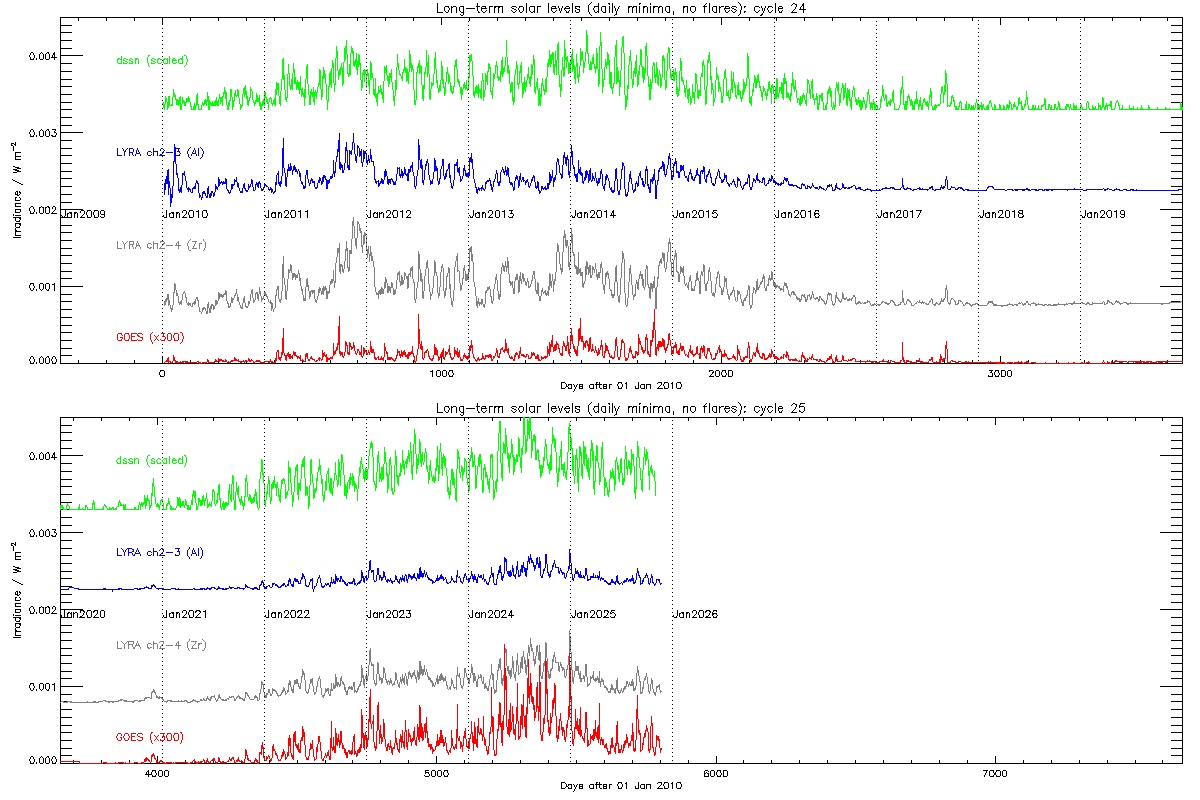
Figure 1
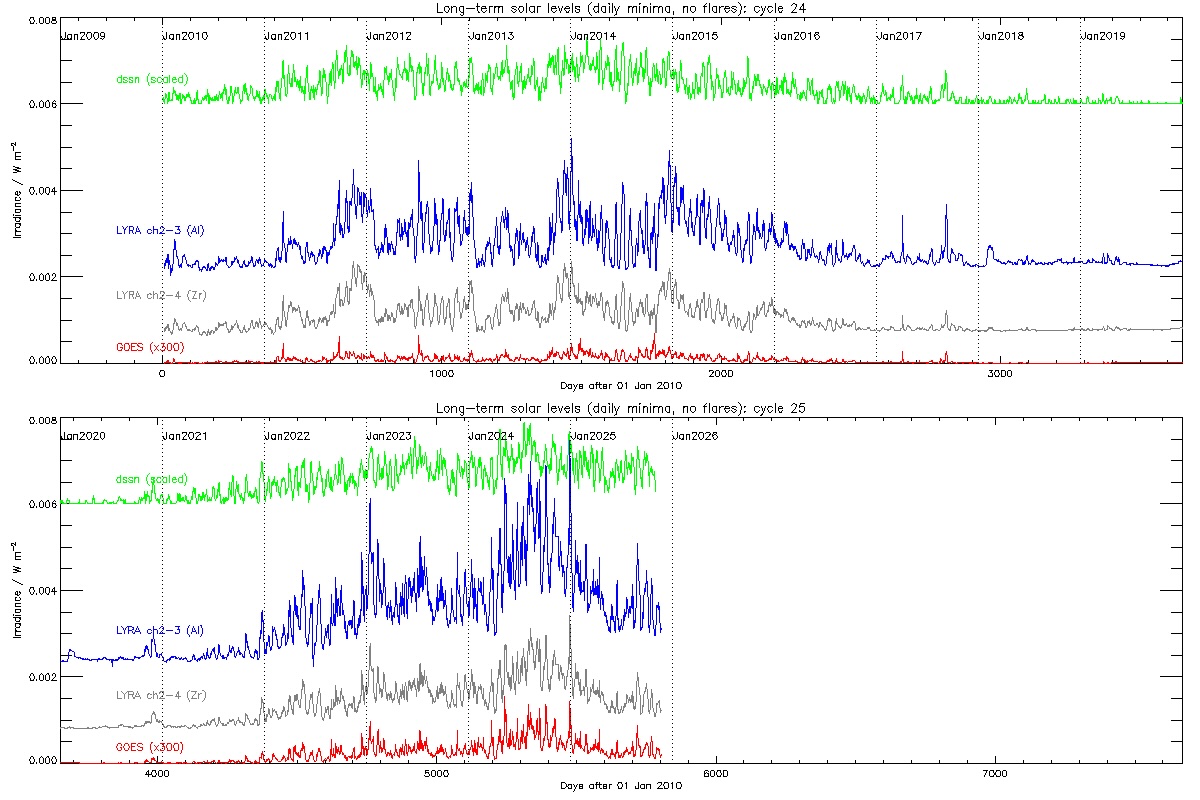
Figure 2
LYRA Latest
SWAP Latest
Carrington Rotation Movie Latest
SWAP Synoptic Image

SWAP Polar Image