Main menu
You are here
PROBA-2 observes annular eclipse on September 21.
On Sunday, September 21, 2025, PROBA2 once again had the opportunity to observe an annular eclipse of the Sun. This marks the 36th eclipse recorded by the spacecraft since its launch in 2009.
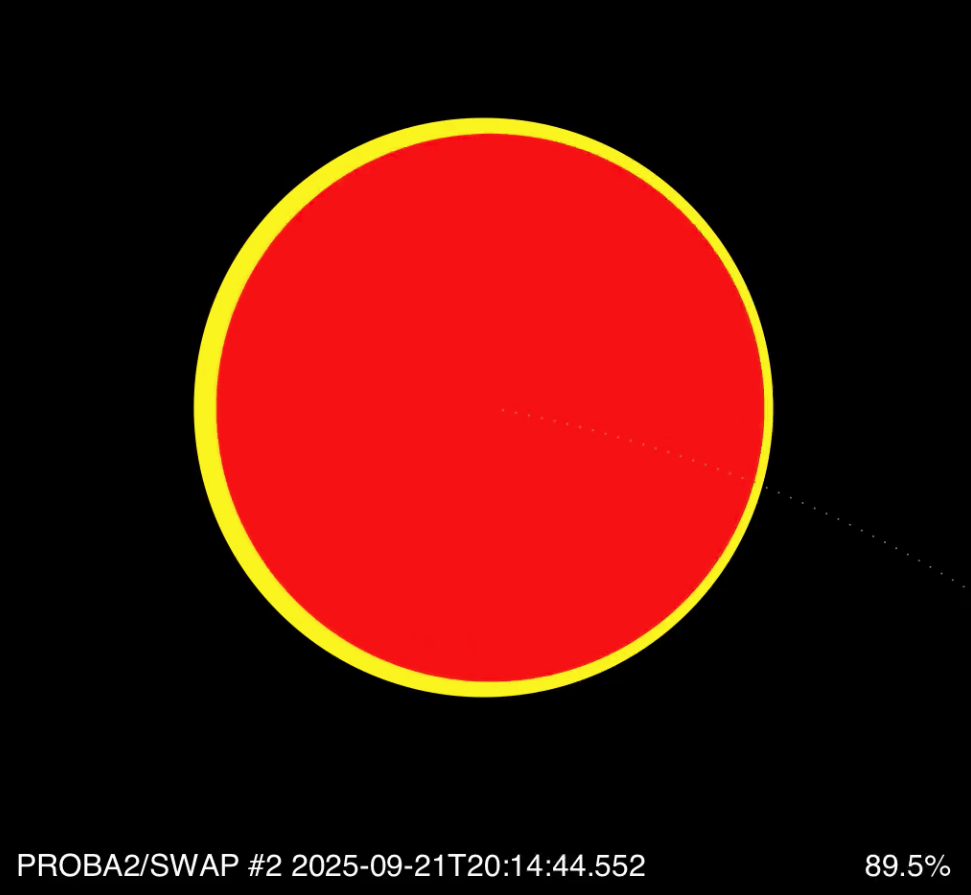
From Earth, only a few people were able to witness the event—visibility was limited to parts of Oceania and Antarctica. However, thanks to its fast sun-synchronous orbit, PROBA2 crossed the eclipse zone multiple times, allowing it to capture several unique perspectives. During its third passage, nearly 90% of the solar disk was occulted by the Moon, producing a striking “ring of fire” effect. Click here to view a simulation of the expected eclipse as seen from the SWAP telescope.
Planned Observations
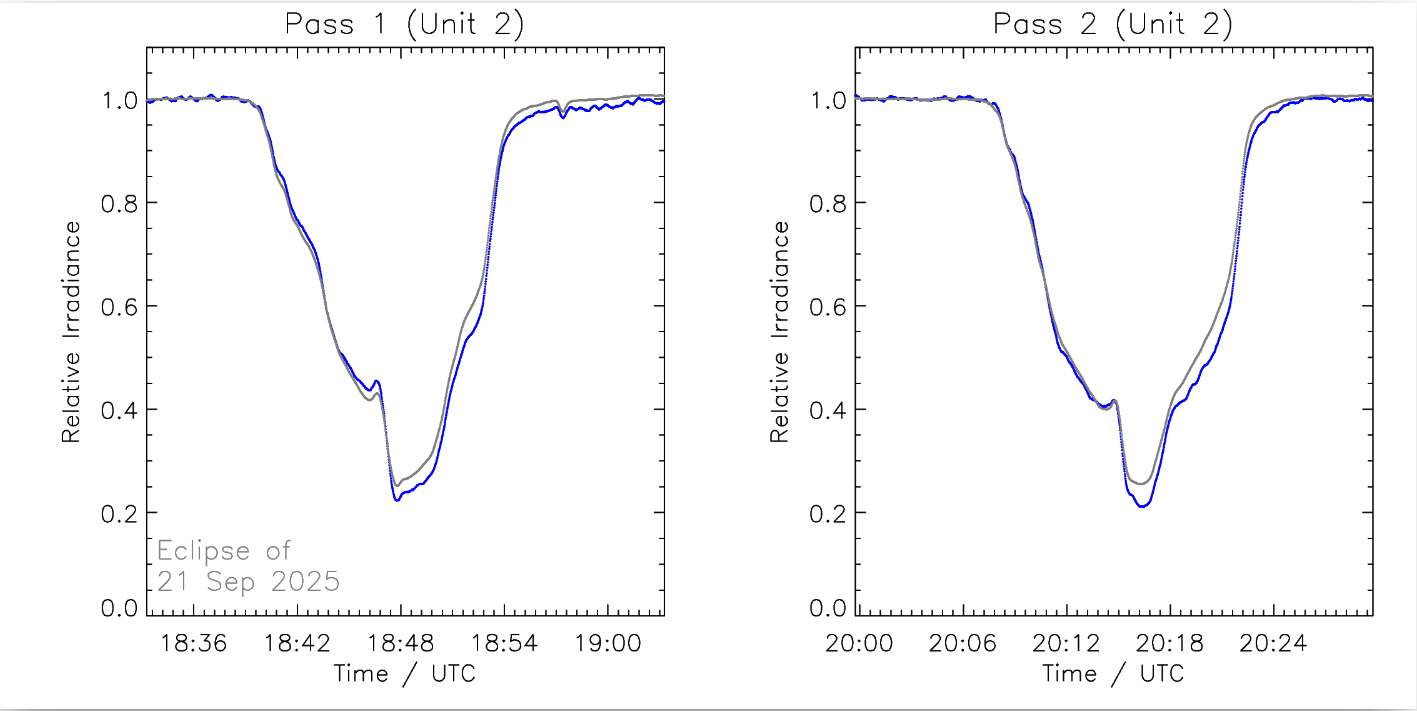
LYRA Observations
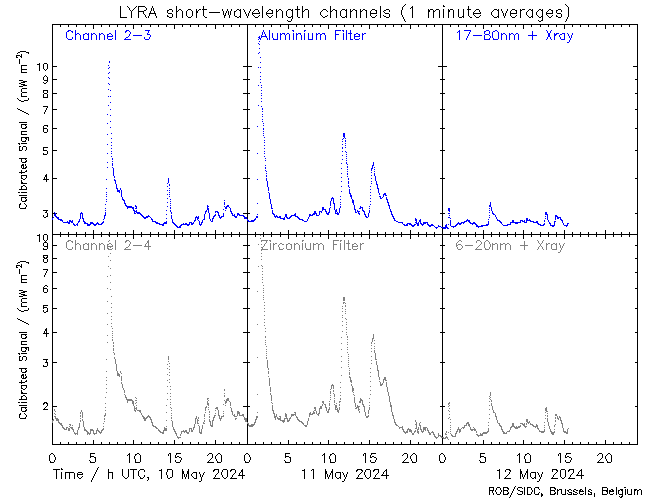
As with earlier eclipses, LYRA conducted a dedicated campaign using one of its backup units to obtain higher-quality measurements. Unfortunately, an instrumental issue caused the data from this backup unit to become corrupted onboard. The nominal data remain available, but only two of LYRA’s channels—the Aluminum and Zirconium channels, here-below plotted in blue and black respectively—provide useful observations. The other two channels have suffered severe degradation over 15 years of space operation and now produce essentially flat signals. The resulting data will be stored in the event directory.
SWAP Observations
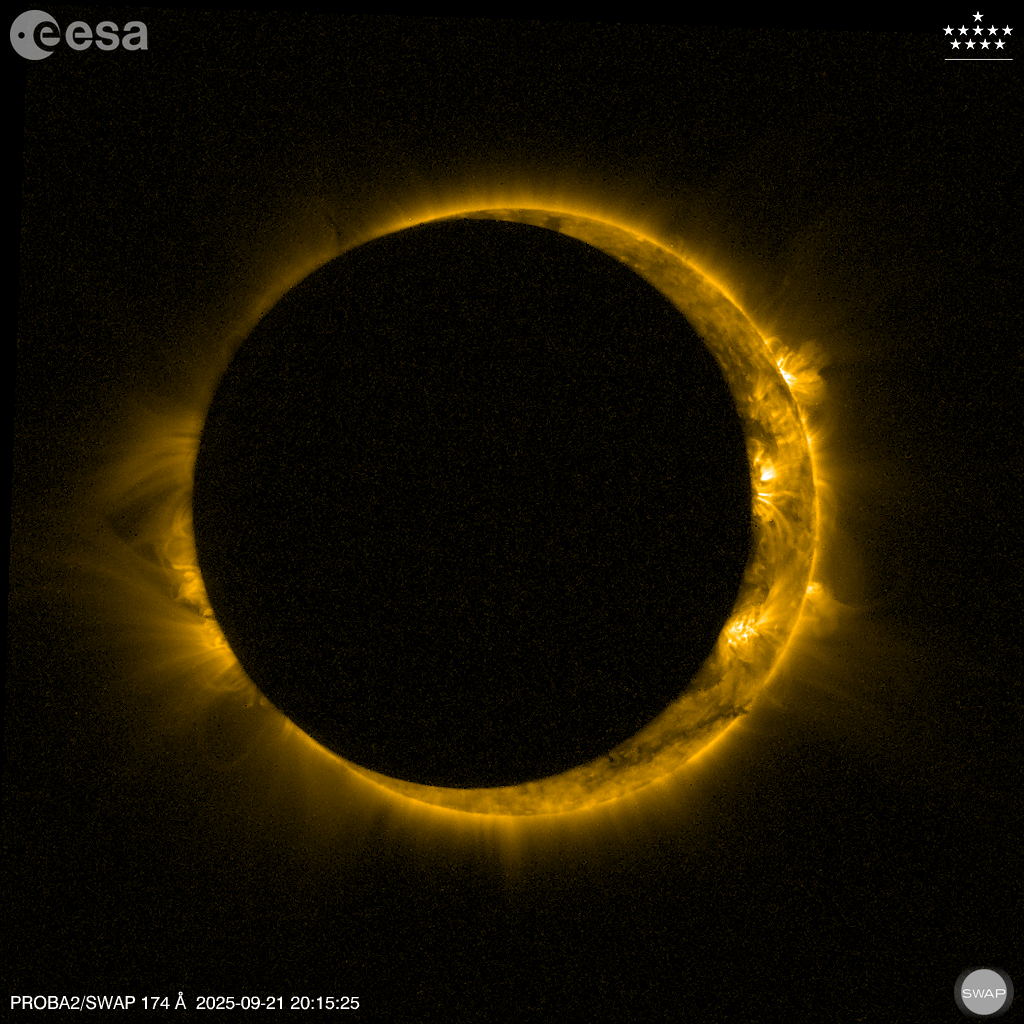
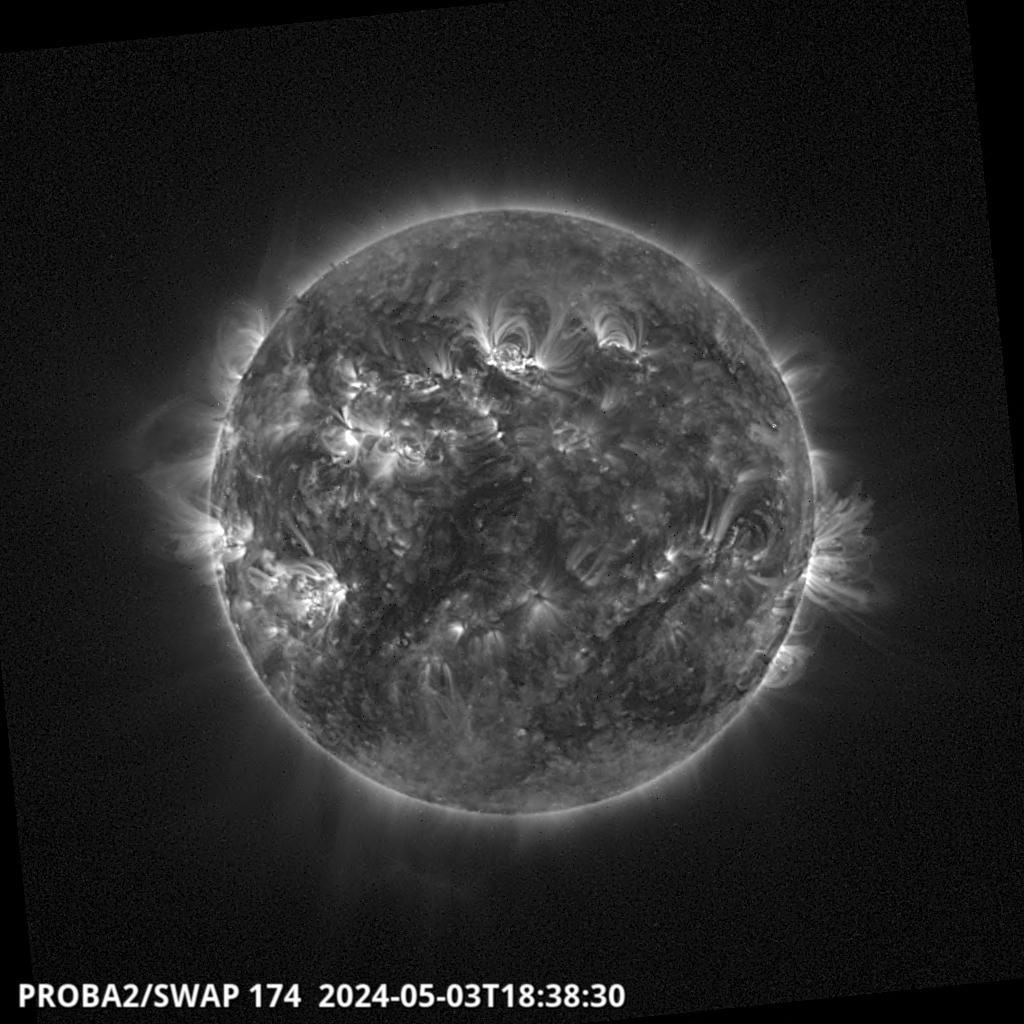
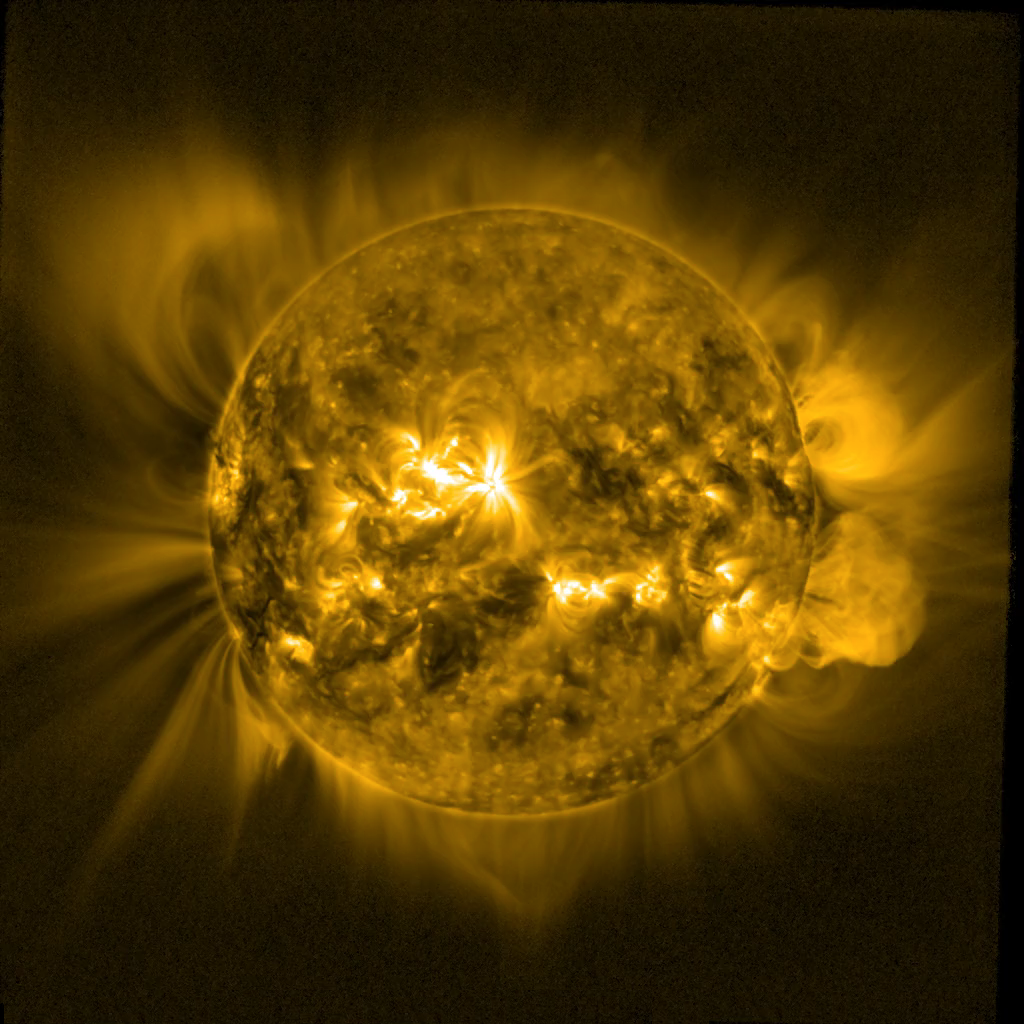
SWAP operated in high-cadence mode, capturing one image every 20 seconds. Calibrated PNG images and movies of the event are be made available in the same directory. During the eclipse, the satellite was not completely stable. The cause of this is still under investigation, but it resulted in blurry images and thus a lower number of usefull eclipse images. The movie below shows the SWAP observations taken for all passages. The software processing SWAP data that should put the Sun in the center of the images also seems a bit confused by the presence of the Moon, resulting in slight jumps of the Sun around the center. Futher image processing should solve these issues.
The SWAP movie also shows very nice solar features and activity. On the left, we see a coronal streamer. In the top left quadrant there is a dark magnetic structure, called a filament or prominence, supended close to the solar rim. Throughout the movie, we see this filament twist and slowly rise until it erupts at the end of the day. In the final shots of the movie another eruption is also seen on the lower right.
On several occasions, white dots and stripes are seen on the SWAP images. These are not instrument malfunctions, but energetic particles hitting the detector when the satelliet crosses the South Atlantic Anomaly.
Click on the image below to see the movie.
Data Use Policy
Contacting the PROBA2 Team
LYRA Latest
SWAP Latest
Carrington Rotation Movie Latest
SWAP Synoptic Image

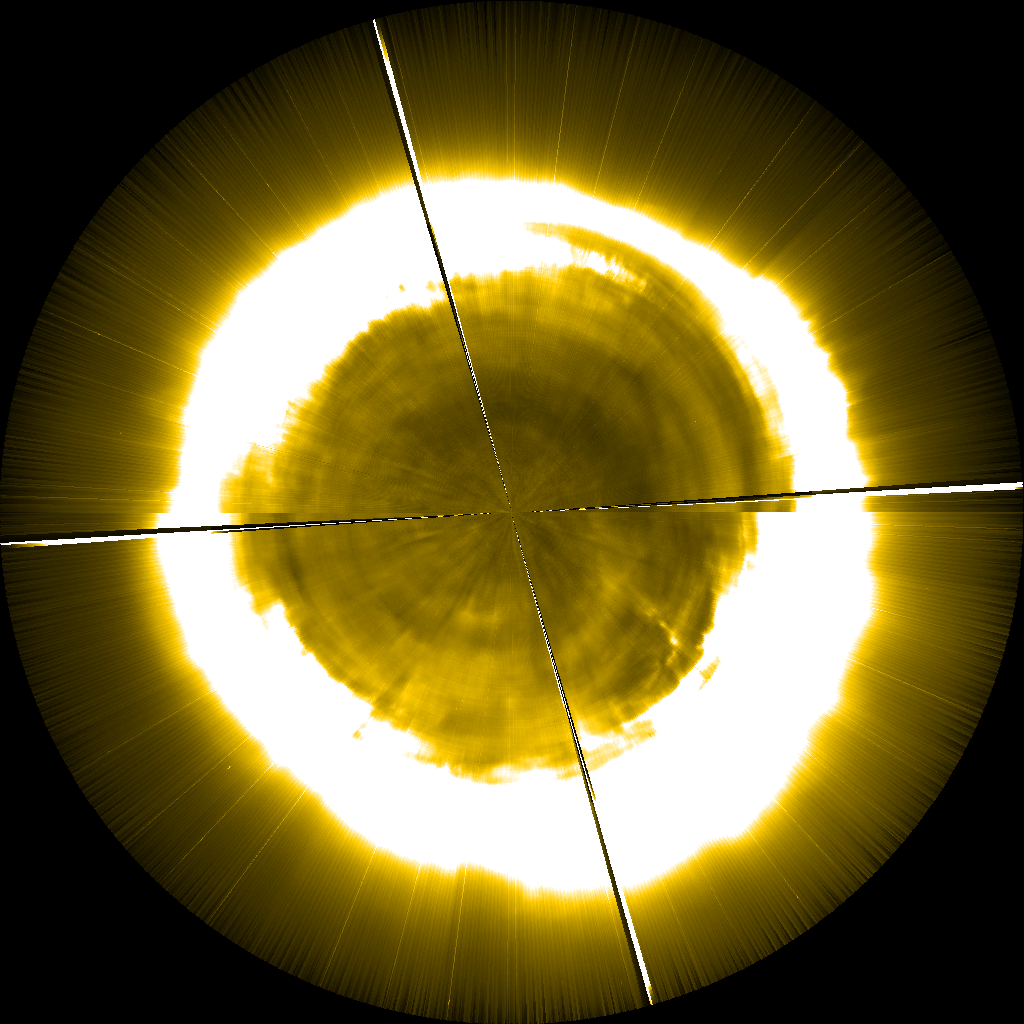
SWAP Polar Image